Lumbar Fusion Recovery: Dr. Hooman Melamed's Real Timeline
Spine surgeon Dr. Hooman Melamed told Mike Torchia what lumbar fusion recovery looks like in his practice: up that night, driving in a week, released at eight.
You have made the decision, or your surgeon has made it for you. The fusion is scheduled, or it is already behind you, and the question has changed. It is no longer whether to operate. It is what lumbar fusion recovery actually looks like: when you stand, when you drive, what you are not allowed to do, and how long before you get your life back.
Most of what people hear about that is secondhand. Bed rest. A year or two before the bone heals. A back that never moves the same way again.
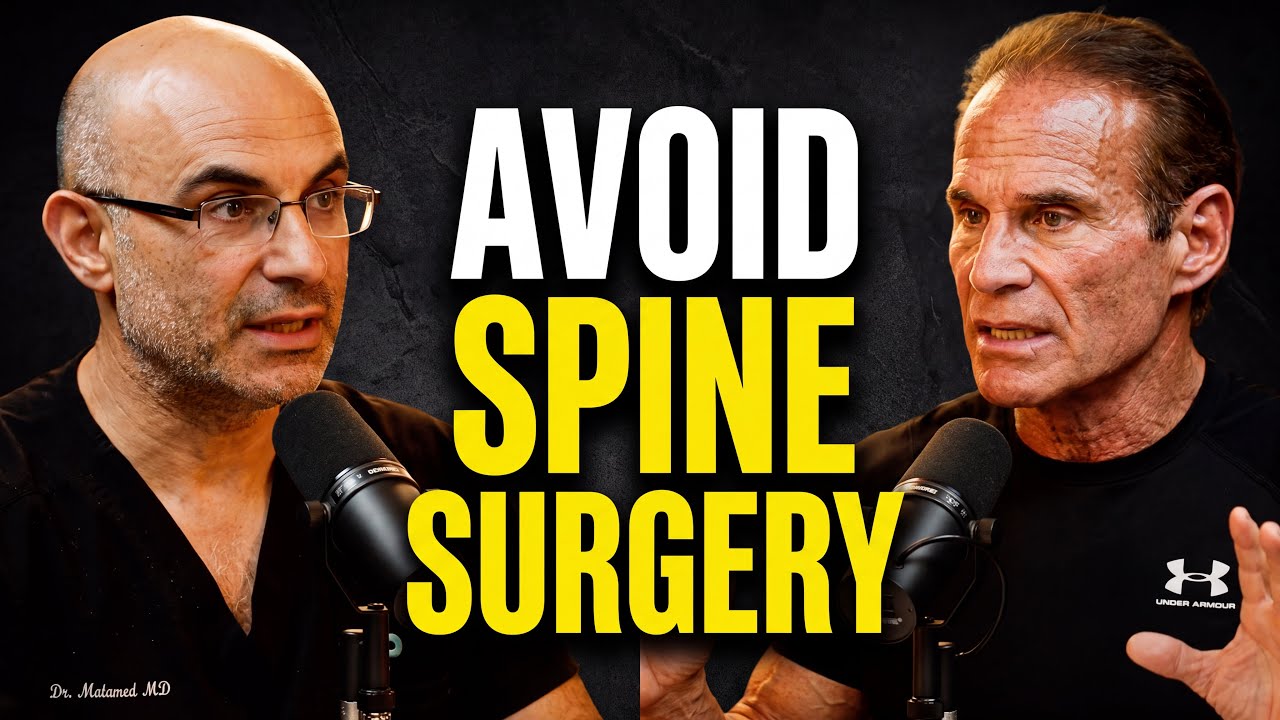
Dr. Hooman Melamed, a board-certified orthopedic spine surgeon, sat down with Mike Torchia on Live Well and Thrive and described how he runs recovery for his own fusion patients. This post covers that part of the conversation. Whether you needed the surgery in the first place is the subject of the earlier post, When Is Back Surgery Necessary?. Every timeline below is his, for his patients. Your surgeon’s timeline governs.
Lumbar fusion recovery starts the same night, not with bed rest
Mike asked how long patients rest before they get back to physical activity. Dr. Melamed’s answer was that he does not believe in bed rest at all. Even after a 14-level fusion for scoliosis, he said, he gets the patient up that night or the next day and walking.
I let them drive after a week. Go for unlimited walks.
His list of what a fusion patient can do in the first weeks was longer than his list of what they cannot. Go to work. Fly. Travel. Do the normal daily things. Movement is part of the healing, not a threat to it, in his view: it circulates everything, supports the immune system, and helps the repair.
He put a number on the bike, too. Mike asked about recumbent bikes, and Dr. Melamed said he starts patients on one after about ten days. For the friend whose spinal infection surgery brought him to the show, the answer to when he could ride was next week.
The one restriction: extreme bending, lifting, and twisting
The rule he gives every fusion patient is short. Be careful with bending, lifting, and twisting, and he means the extreme versions. Brushing your teeth is fine. Sitting down to put your socks on is fine. Forcing yourself down to pick something heavy off the floor is not. The gym is where he draws the hard line: no exercise that strains your back until the bone takes. Light band work is allowed because, again, movement helps.
The reason for the restriction is not fragility. It is capacity. Dr. Melamed compared it to a hard leg workout: you are sore the next day and you do not repeat the session 24 hours later. A fresh fusion is the same. Ask too much of it too early and, in his words, the body does not have the resources or the reserve to heal.
So the shape of what not to do after spinal fusion is narrow and specific: nothing that loads the spine hard, nothing that twists it under weight, and no rush back to the weight room. Everything else is walking, working, and living.
Bone heals in about six weeks, and he releases most patients at eight
Mike had been told by the surgeon who replaced his hip that bone takes a year and a half to two years to fuse. Dr. Melamed said no. What takes years is remodeling. The healing itself follows the pattern of a fracture.
Fracture healing is typically about six weeks. When I do a fusion on a patient, usually by eight weeks, I cut them loose.
The conditions attached matter as much as the number. He said this holds when the patient has good biology, the surgery was done correctly, and the construct is mechanically stable. Under those conditions he says he can show CT scan after CT scan of solid fusions at eight weeks. For bigger fusions across more levels the window runs six to eight weeks depending on the case, and at eight weeks his instruction is to start ramping up.
That is his lumbar fusion recovery timeline, in his practice, for his patients. It is not a promise about yours. What it tells you is that the years-long story you may have heard is about remodeling, not about when you can move.
He offered one long-range proof point. His aunt had a fusion at 84, done by him, and is now 99. Fusion done well, he told Mike, comes down to who does it and how.
Muscle falls asleep after surgery, and recovery means waking it up
Here is the part of lumbar fusion recovery that Dr. Melamed says gets missed most. After an injury, and especially after surgery, the muscles around the operated joint can stop activating properly. The term is arthrogenic muscle inhibition, or AMI, and he said it happens to the knee, the hip, and the spine alike.
If your muscles are not working properly, you will have tons of joint pain, tons of back pain, because the muscles are not supporting the joint.
His clinical point is that a fusion stabilizes a segment, but it does nothing for the muscle that went quiet around it. He described patients who came to him after being told they needed an operation, whose MRIs showed very little muscle at all, and who had never been told. In his words, replacing the disc does not fix back pain that comes from muscle loss. The muscle has to be rebuilt, before surgery or after it.
He named the tools he uses in his office for that job: EMS, traction, what he calls focused shock therapy, and a body composition scan to track lean muscle mass and visceral fat. Mike’s own recovery is the same idea applied at home. After his 2003 motorcycle accident, his lower spine fused on its own from S1 to L4, and an orthopedic surgeon told him nothing could be done about the scar tissue. Mike went to soft tissue specialists instead: traction, red light therapy, hyperbaric oxygen, PEMF, and acoustic wave work to break up the scar tissue. He says he is pain free. Dr. Melamed’s response was that this is exactly the muscle work that wakes an inhibited joint up. Mike describes those tools on the biohacks page.
One line on training, because another post from this episode covers it in full: Dr. Melamed uses blood flow restriction training with patients to help recovery after surgery, and trains with it himself.
Inflammation before surgery decides how you heal after it
If you are still ahead of the operation, this is the section for you. Dr. Melamed’s view is that a body full of inflammation cannot heal, from an injury or from surgery, and that this is why some of his patients are told to wait.
If you have inflammation in the body, you can’t heal. You’re not going to heal from your injury.
He said he has waited six months, and in some cases a year, before doing a patient’s surgery so that they heal from the inside out and get the result. Mike put the same principle in training terms: people want to start a comprehensive program while carrying an unaddressed problem, a thyroid issue, a gut issue, an old injury, and it does not work. Dr. Melamed agreed. You cannot isolate the spine, he said: look at the whole person or it bites you.
He extended the argument past the operating room. Surgery, in his words, is short term; the lifestyle decides whether it holds. Nutrition was his example. When he was an inpatient for two days after his own surgery, the hospital brought French toast with maple syrup and eggs cooked in seed oil, and he ate nothing the hospital served. What he says a healing patient should get instead is high protein, pasture-raised eggs, avocado, vegetables, and low carbohydrate; for his own hospitalized patients he tries to arrange an anti-inflammatory, gluten-free version of that and tells families to bring food from outside. That is his protocol for his patients, not a prescription for you. Mike’s summary was blunter: a hospital treats you, and getting healthy afterward is your job.
If a complication happens, what matters is what the surgeon does next
Nobody plans for this part, and Dr. Melamed was direct about it. Complications happen to every surgeon. An artery can be hit. A screw can end up against a nerve. The question he asks when he is called to review another surgeon’s case is not whether it happened but what the surgeon did about it.
He told his own story. In 2010 or 2011, during a four-level fusion in the neck, one of eight screws was misplaced and the patient woke with severe arm pain. He ordered a CT scan, saw the screw off the bone and against the nerve, told the patient immediately, and went back in to replace it. The patient later told him about calling a friend in doubt, and the friend’s answer was that a surgeon who tells you is the one to trust.
There’s no shame because we’re not perfect. You recognize it, you take the patient back, you fix it.
The contrast he drew is the reason to know this before you need it. He has seen patients suffer for a year or a year and a half because a surgeon kept saying the X-rays looked fine, ordered more epidurals and more narcotics, and never got the CT that would have shown the screw. A complication recognized and corrected can cost a week; a complication hidden can cost a year. Patients, he said, are okay with complications. What they are not okay with is a surgeon who is not transparent.
The same applies to your rehab. After his own ACL reconstruction, Dr. Melamed needed 70 physical therapy sessions, and his insurer tried to stop at 24. He appealed, and more sessions were approved. His advice was that patients need to be their own advocates: call, push back, and say plainly that you know your body. If your physical therapy during lumbar fusion recovery is cut short before you are ready, that is a phone call worth making.
How this fits the Operation Fitness method
Mike said on the show that people want to start a program without addressing the health issue underneath it, and Dr. Melamed’s approach to lumbar fusion recovery is the surgical version of the same rule: prepare the person, then operate, then rebuild the muscle. That is the order Operation Fitness works in. Tested, not guessed. Health issues first, the program second. Every program is designed by Mike and delivered by his team, and every one is built for the person it is for. If you are coming off a fusion, that starts with your surgeon’s timeline.
Where to go from here
Watch the full conversation with Dr. Melamed at https://www.youtube.com/watch?v=BWpowKxfvls.
See the recovery tools Mike used on his own spine on the biohacks page.
If you are coming out of a spine surgery and want a program built around it, request a consultation. Mike reads every message.
QUESTIONS PEOPLE ASK
What should you not do after a lumbar fusion?
Dr. Melamed's restriction for his fusion patients is extreme bending, lifting, and twisting until the bone takes, plus no gym work that strains the back. Everyday movement such as brushing your teeth or putting on socks is fine, walking is unlimited, and light band work is allowed. His other caution is doing too much too early, which taxes the body's reserve to heal. Your surgeon's instructions for your case govern.
Is a body composition test useful after back surgery?
Dr. Melamed named a body composition scan, the InBody type, as one of the tools he uses in his office during recovery, because it breaks down lean muscle mass and visceral fat. His reason is that muscle loss around the spine is what he sees on many patients' MRIs as the driver of their pain, so tracking whether the muscle is coming back matters. Whether it is right for you is a question for your care team.
Does red light therapy help back pain?
The episode offers one person's account, not a study. After a 2003 motorcycle accident, Mike Torchia's lower spine fused on its own and a surgeon told him nothing could be done. Mike used soft tissue work, traction, red light therapy, hyperbaric oxygen, PEMF, and acoustic wave treatment on the scar tissue, and says he is pain free today. Dr. Melamed called that the muscle work that wakes an inhibited joint up. Mike describes these tools on the biohacks page.
How many physical therapy sessions will insurance cover after spine surgery?
General context: plans vary and set their own limits. On the episode, Dr. Melamed said insurers usually cut physical therapy off around 18 to 24 sessions, and that after his own ACL reconstruction he needed 70. He appealed, and more sessions were approved. His advice was that patients need to be their own advocates: call the insurer, push back, and say that you know your body.
KEEP READING