Blood Flow Restriction Training: Dr. Melamed on Lifting After 35
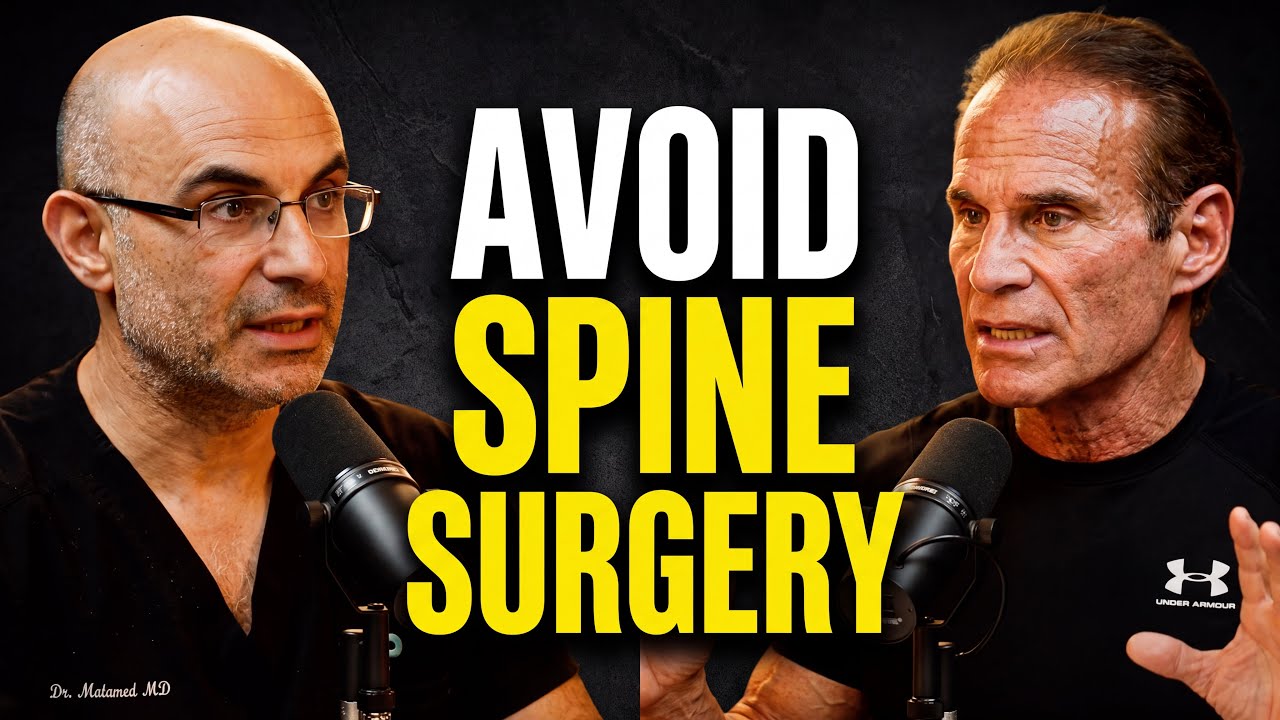
Spine surgeon Dr. Hooman Melamed told Mike Torchia why he trains with blood flow restriction, why 12 reps is his floor after 35, and what protects the joints.
You are past 40, maybe past 50, and the lifts that built you have started landing in the wrong places. The squat you feel in your spine instead of your legs. The press that lights up a shoulder before the chest gets tired. You still want muscle, and you have started to wonder whether wanting it is the problem.
Blood flow restriction training is one of the answers a spine surgeon gave when Mike Torchia put that question to him on Live Well and Thrive. Dr. Hooman Melamed, a board-certified orthopedic spine surgeon, came on the show after operating on a close friend of Mike’s, and once the surgery talk was done the two of them spent a stretch of the episode on something more useful to most listeners: how to keep building muscle after 35 without spending your joints to do it.
What follows is that stretch, built from the episode. The training statements belong to Dr. Melamed or to Mike, in their own words where the words matter. If your question is whether you need an operation at all, that is a different post: when back surgery is necessary covers his framework for that decision.
Muscle can be kept into your 80s, but the joints age anyway
Mike opened the exchange with his own history. He squatted for decades as a bodybuilder and strongman competitor, working up to 650 pounds, deep, with a belt and never with knee wraps, because he wanted the muscle to do the work. Then something changed. Even at 315 for sets of 15 to 20, he said, he stopped feeling the weight in his legs and started feeling it in his spine.
Dr. Melamed’s explanation is the premise for everything else in the episode. Studies have shown, he said, that you can maintain muscle mass well into your 80s. What you cannot do is stop the joints from aging: the spine, the knees, the hips. The joint is what takes the pressure, so the joint sets the limit, not the muscle.
He added a variable most lifters never think about: stature. A six-foot-five lifter with a big frame has more surface area and joints that can carry more load. A shorter lifter covers less distance on every rep, and since work is force times distance, the shorter person generates less work per rep, tires more slowly, and ends up pushing heavier weights than the frame was built for. That, in his words, is why the shorter, stockier lifter hurts himself more often; the taller lifter’s own mechanics protect him.
Twelve reps is the floor, not the target
Mike asked the direct question: what should a person over 35 do differently? Dr. Melamed gave a number and then explained the number. Twelve reps minimum once you pass your mid-30s. Mike asked why 12 rather than 20, and the answer was that 12 is not the target. Fifteen is fine. Twenty is fine. Just not fewer.
A higher rep, that means the weight is not heavy enough to affect your joints.
That is the whole case for high reps low weight as he sees it. The rep count is a proxy for load. A weight you can only move six times is, by definition, heavy enough to torque a joint; a weight you can move 15 times is not. For someone five-nine or six feet tall, his advice was blunt: do not try to go under 12, because you are pressuring your joints more than the frame can absorb.
He did not give a set count, a weekly split, or a percentage of a max, and this post does not add any. Strength training over 40, in his framing, is about the load the joints see, not the effort the muscle feels.
Blood flow restriction training makes 200 pounds feel like 400
Here is where Dr. Melamed went past reps. There is a method, he said, that he uses with patients to help recovery, whether or not they have surgery, and that he now trains with himself: blood flow restriction, or BFR.
If you use BFR, let’s say you’re doing 200 pounds, your body will think you’re doing 400 pounds. The muscles will think you’re doing 400 pounds.
He described the effect from the muscle’s side: a set of 20 with restriction registers in the body like a set of two at a far heavier weight, and that is how you get the stimulus without the load. Mike finished the thought, “without the pressure on the structure,” and Dr. Melamed agreed. He said a lot of pro sports teams now use it, and that he works out with it.
What he did not say matters as much. He named no brand, no cuff, no pressure setting, and no protocol, and this post adds none. Blood flow restriction training, as it came up on the show, is a spine surgeon’s answer to one problem: a heavy-weight stimulus from a light-weight load when the joints have become the limiter. If you want to try BFR training, that is a conversation with a physician or a coach who has used it, not a purchase.
Mike’s adjustment: pre-exhaust, then five sets of 20 on the Smith machine
Mike’s own solution predates the episode and lines up with the surgeon’s rule. When barbell squats started compressing his spine, he moved to the Smith machine, and when 225 on the Smith machine still felt like it was compressing his spine, he took the weight down again. The method he settled on: pre-exhaust the quads and hamstrings first, then squat on the Smith machine with a modest load for about five sets of 20 reps. With the legs already tired, a light weight does the job, and in his words there is no pressure on the spine.
I got a really great burn. Still, my legs look full and have great shape, but I’m not doing three, 400 pounds anymore.
Dr. Melamed’s one-word response to the Smith machine itself was “depends,” and he did not go further on the equipment. What he confirmed was the observation that drove Mike’s change: the joints, not the muscle, were what had aged. The principle underneath is the one this whole episode keeps returning to. Tire the muscle so the joint never sees a heavy load. That is the 12-rep floor, BFR, and pre-exhaust, reached three different ways.
Cosmetic muscle is not functional strength
Mike asked what a person should do about a sharp pain after overdoing it in the gym, and Dr. Melamed answered with a distinction instead of a remedy. Bodybuilding, he said, is not what he calls functional strength.
Calisthenics is real strength. It’s real functional strength. Bodybuilding works really in one plane.
His argument: a barbell movement trains one visible set of muscles in one plane. Calisthenics, and Pilates as a form of it, recruit muscles you did not know you had, the invisible stabilizers most lifters skip. Because so many muscles work at once, you fail fast, and because you cannot load body weight to extremes, you are not in danger of damaging your joints. Chin-ups, dips, and push-ups on park benches: he called the people who train that way urban athletes, and said it is very hard to hurt yourself using your own body weight. The example he gives patients is Tom Brady: a lot of band work, no heavy weights, and a long career.
Mike had arrived at the same place on the road. When travel kept him out of a gym, he did chin-ups on a tree branch and incline push-ups with his feet up on the trunk, with short rests, and got what he called the most vicious pumps of his life. He kept his shape that way and never dropped his core work. Dr. Melamed’s name for what barbells build on their own was cosmetic muscle. The stabilizer muscles you cannot see are what protect the joint.
The proof story is a friend of both men, a late bodybuilder and author Dr. Melamed operated on when the man was 56 or 57. Everyone had written him off as done competing. He did not need a fusion; Dr. Melamed did a minimally invasive decompression at a couple of levels, and the man trained his way back with bands and body mechanics rather than heavy iron. About a year and a half after the surgery he won first place in a masters competition. Functional strength training, in the surgeon’s words, is how you get strong, how you prevent injuries, and how you protect your joints for the long run.
The muscle nobody sees on the MRI is the reason you hurt
Why does any of this matter more after 50? Because muscle loss with age, sarcopenia, does not only change how you look. Dr. Melamed said the phrase people use is that muscle loss is the key to longevity, and he sees the mechanism on scans.
How are you going to get better with no muscles? Look at your MRI. You have no muscle.
That is what he tells patients who arrive having been told they need an operation. In a lot of those cases, he said, the MRI shows a lot of muscle loss and nobody has mentioned it. His position: replacing a disc does not fix pain caused by missing muscle. You have to get the muscle back first. After an injury or surgery, the muscle around a joint can go quiet, a condition he called arthrogenic muscle inhibition, and a joint without working muscle hurts, whether it is a knee, a hip, or a lumbar segment.
That is the case for training after 35 in one line: the muscle is the support structure, and the training has to build it without wearing out the joint it supports. Every method above, the 12-rep floor, blood flow restriction training, pre-exhaust, calisthenics and bands, is a way of doing exactly that.
How this fits the Operation Fitness method
One question new clients bring to Mike, in their own words, is “I want to put on some muscle, but I’m 55 years old. Is it possible?” This episode is a spine surgeon answering yes, with conditions. Mike said on the show that people want to start a program without first addressing their health issues, and Dr. Melamed agreed that you cannot isolate the spine from the rest of the body. Mike’s programs work in that order: tested, not guessed, with the joints and the health issues assessed before the load is chosen, designed by Mike and delivered by his team. See what that looks like on the programs page.
Where to go from here
Watch the full conversation with Dr. Melamed at https://www.youtube.com/watch?v=BWpowKxfvls.
See how Mike builds a program around an aging frame on the programs page.
If you want muscle back and your joints are the thing in the way, request a consultation. Mike reads every message.
QUESTIONS PEOPLE ASK
Is muscle loss the real cause of back pain after 50?
Often a contributor, in Dr. Melamed's experience. He said he sees a lot of patients who were told they need surgery when their MRI shows a lot of muscle loss that nobody mentioned, and that replacing a disc does not fix pain caused by missing muscle. Muscles support the joint; when they stop working, the joint hurts. He named sarcopenia as the reason people call muscle the key to longevity. Get the muscle back first, he said.
How many reps should you do to build muscle after 40?
Dr. Melamed's answer on the episode was a floor, not a formula: 12 reps minimum per set once you pass your mid-30s, and 15 or 20 is fine. His reasoning is that a weight you can move for 12 or more reps is not heavy enough to stress the joints, and joints age even when muscle can be maintained into your 80s. He gave no set counts or weekly volume, and neither does this post.
Are squats bad for your back, and are Smith machine squats safer?
Neither man said squats are bad. Mike Torchia squatted up to 650 pounds for years, then moved to lighter Smith machine squats when heavy loads started landing in his spine instead of his legs: pre-exhaust the quads and hamstrings, then about five sets of 20. Asked about the Smith machine, Dr. Melamed said it depends, then talked about joints and rep count, not equipment. If squats hurt your back, ask a physician.
Does blood flow restriction training work?
Dr. Melamed's view on the episode is yes: with BFR, a 200-pound lift makes the muscle respond as if it were 400, the stimulus of heavy weight without the pressure on the joints. He said pro sports teams use it and he trains with it himself. General context, not from the episode: BFR limits blood flow to the working limb with a band or cuff during light lifting. He named no equipment, pressure, or protocol; do not guess at one.
KEEP READING