Exercise and Brain Health: Why Sebastian Siegel Never Skips Legs
Exercise and brain health, from the leg-day side: Sebastian Siegel and Mike Torchia on squats, intensity, and why hard training keeps them sharper.
You walk out of a long meeting and cannot find the word you wanted. The afternoon goes soft around the edges. You are not sick, and your doctor may have nothing to show for it, but you are not as sharp as you were at 40. If you have typed “exercise and brain health” into a search bar, you are probably hoping for something more concrete than “move more.”
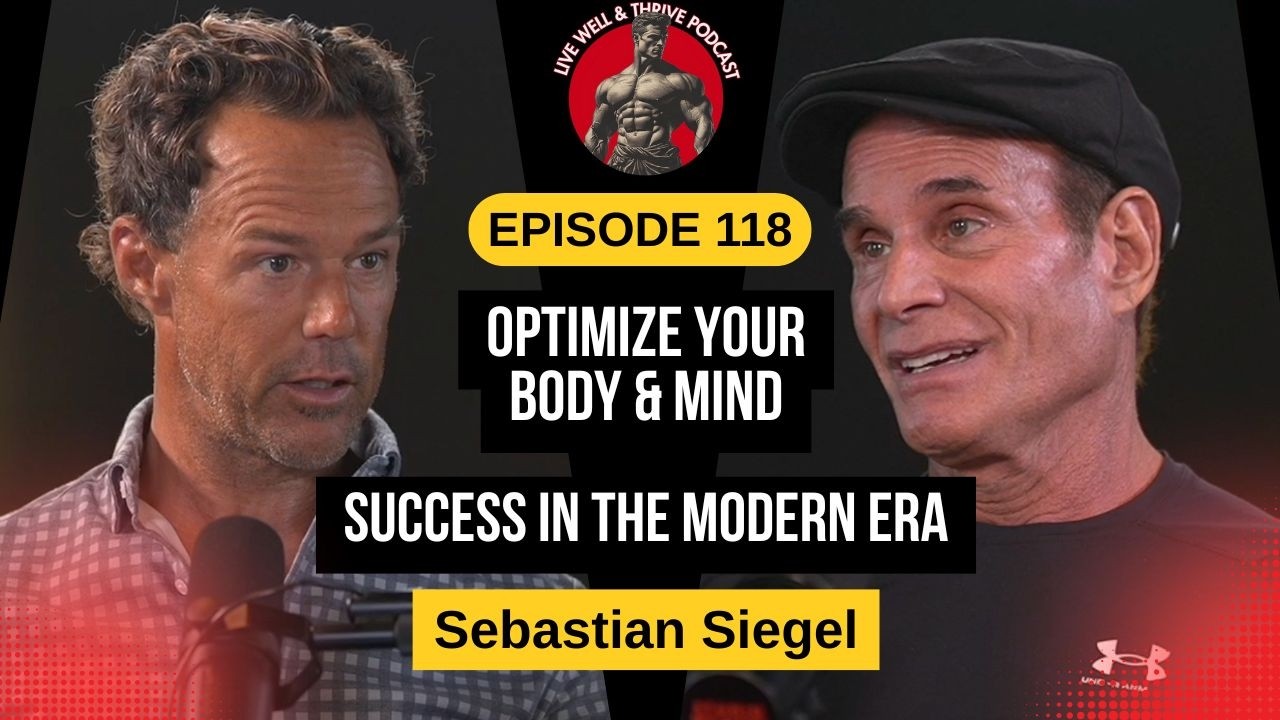
Episode 118 of Live Well and Thrive gives you a specific answer, and it starts at the legs. Mike Torchia sat down with Sebastian Siegel, a filmmaker who, by his own count, has appeared on more than 100 fitness magazine covers. Both men have trained hard since they were teenagers. Both say the hardest days in the gym are the ones that keep their heads clear. This post lays out what they said, who said it, and where the evidence ends.
Exercise and brain health start with the basics, not a pill
Sebastian opened the conversation with a complaint about the longevity market. Too many people, he said, want to take a peptide to get smarter instead of doing the work. He allowed that a product might help a little, a few percent. If the core is missing, the extra few percent does nothing. By the core he meant hard physical exercise, reading and trying to get better, feeling good, and being of service to the people around you.
Mike agreed and gave his own list: hard work, proper nutrition, plenty of rest, and avoiding toxins, which for him includes toxic people. He learned the first three from Arnold, whom he met at Gold’s Gym at 15. At 69, he says, he still follows that blueprint.
You can’t be relying on drugs or peptides or any of this other stuff. That should augment what you’re doing.
That is the frame for everything below on exercise and brain health. Neither man is selling a protocol for your brain. Their claim is that the training itself, done hard and done for years, is what keeps them thinking clearly.
The benefits of training legs start with not skipping them
Sebastian got his first leg press at 14, when his high school installed one. He and a friend did as many sets of 20 as they could manage, holding their breath on the way down and yelling on the way up. He could miss a biceps day or a chest day as a kid. He never missed legs.
He still trains them that way. If he misses several days of everything else, he says, he will not miss squats, leg presses, lunges, leg extensions and curls, or carrying people up the stairs. Mike had watched him train and called his physique balanced, every area worked evenly, which is why it still looks the way it does.
Mike told a story of his own. As a teenager he went to Bill Pearl’s gym in Pasadena and asked Pearl, a former Mr. America and Mr. Universe, which exercise he would keep if he were stuck on an island with only one. Pearl’s answer was squats. As Mike tells it, Pearl said your legs are half your body, that squats work the heart and lungs, and that squatting stimulates growth in your upper body too. Those are Pearl’s claims, retold by Mike, and they are the closest thing to a summary of the benefits of squats this episode offers.
Mike took the advice. Legs became his strongest body part in competition, and he still squats.
When I get under that bar, I just feel my quads on fire, my glutes, my hamstrings, my calves. I’m high from it.
When someone at the gym groans that it is leg day, he says, his reply is that it is his favorite, and he offers to do it with them.
High intensity training matters more than the weight on the bar
Sebastian pointed to sprinters, ice skaters, and rugby players. For years, he said, many of them did little weight training, yet their legs and glutes were highly developed and the rest of their bodies were lean. His explanation is what he called the anabolic response that hard leg work produces. Then he drew the line most people get wrong.
Heavy or light, high intensity is where the action is at.
People assume it is about training heavy, he said. Sometimes it is. The variable he cares about is how hard you work. That is high intensity training in the plain sense of effort under load, not interval cardio. It also means the weight on the bar is less important than whether you finish the set with nothing left.
His own sessions show what he means. He does not count much. On leg press, squats, sled pushes, or lunges, he goes again and again, 10 sets, then one more, then something else. He says he would probably get a better physical result if he trained less. He keeps going because he is training to find his limit for the day, and the physique is a byproduct.
What a twin study suggests about leg strength and brain health
The center of the episode came at about the 50-minute mark. Sebastian talked about the research on being able to stand up from a chair and not fall as people age, which he described as a marker of lower mortality. That is the leg strength and longevity link most people have heard of.
Then he went further. He cited a twin study from King’s College London that, as he described it, followed identical twins through middle age and compared them years later. In his telling, the twin with the stronger legs had better brain activity and better problem solving. He told listeners they could look it up, and you should read the paper itself rather than rely on a podcast summary of it, including this one.
Sebastian’s explanation for the link is his own: the drive, the hormonal response, and the blood flow that hard leg training sends through the body and the brain. Then he described what he notices.
I know when I work out really hard I’m so much sharper. I can see the puzzles clear.
He says he identifies patterns better and thinks more clearly about his work in film, psychology, and health on the days he trains hard. If you are looking for how to improve cognitive function, that is his practical answer: train, and train your legs.
Be precise about what was not said. If you searched “leg strength and dementia,” no one on this episode claims that strong legs prevent dementia. The study, as Sebastian described it, measured brain activity and problem solving in healthy adults. A concern about memory or cognition belongs with your physician. What the episode offers on exercise and brain health is a reason to keep your legs strong as you age, and two men who say it keeps their brains sharp.
Small habits for brain fog that Mike adds to the day
Not every answer on exercise and brain health requires a squat rack. Mike described a habit he has built into workplace programs he designed: a brain break every 20 minutes. You stand up, drink some water, and let blood flow return to the head before you sit back down. His point was productivity. Twenty minutes at a desk is long enough to stand up. If you want exercise for brain fog that fits inside a workday, that is the smallest version of it.
He also talked about the lower legs. Mike says the calves are the biggest pump in the body. He told Sebastian that cardiologists he has spoken with recommend calf raises on the stairs for heart patients, because the movement helps push blood back toward the heart and the brain. That is Mike’s account of those conversations, not a study, and if you have a heart condition the routine is your cardiologist’s to set.
Sebastian added one habit of his own. He has never taken his phone into the gym. Whatever else that does, it keeps the hour about the work.
How to keep your brain sharp as you age, the Operation Fitness way
Mike closed this part of the conversation with what bodybuilders learn from a year of contest preparation: training without missing sessions, eating to plan, and skipping the parties. That builds mental strength, he said, and you can channel it toward anything you want to do. Sebastian put it his own way.
You don’t know the limit until you push it, and I train for that.
That is the logic behind how Operation Fitness builds a program. It starts with testing, it is designed by Mike, and his team delivers it, with leg strength treated as a long-term asset rather than an afterthought. You can see how training, nutrition, and recovery fit together on the programs page. If you are rebuilding strength later in life, the post on building muscle after 50 covers the training side in more detail, and precision medicine and longevity covers the testing that comes first.
Where to go from here
Watch the full episode with Sebastian Siegel on YouTube. See how a plan is put together on the programs page. If afternoon fog and weaker legs are starting to feel like your new normal, book a consultation and start with where your body is now.
QUESTIONS PEOPLE ASK
What causes brain fog, and can exercise help?
This episode does not cover the causes of brain fog, and a fog that will not lift is a question for your physician. What it offers is the training side. Sebastian Siegel says hard workouts, legs above all, leave him sharper and better at seeing patterns. Mike Torchia adds a habit he has used in workplace programs: stand up every 20 minutes, drink water, and get the blood moving again before you sit back down.
What is the sit to stand test?
The episode does not describe the test or how it is scored, so this post will not give you a protocol. Sebastian Siegel refers to the research on being able to stand up from a chair and not fall as people age, and he describes that ability as a marker of lower mortality. If you want to be assessed, ask your physician or a qualified trainer to run the test in person.
Are calf raises good for circulation?
Mike Torchia's view is yes. He says the calves are the biggest pump in the body, and that cardiologists he has spoken with recommend calf raises on the stairs for heart patients because they help move blood toward the heart and brain. That is his account of conversations, not a study, and no one on the episode gave a routine for you to follow. Ask your cardiologist before you start one.
Should you lift heavy weights or light weights?
Sebastian Siegel's answer is that the load is the wrong question. People think it is about training heavy, he says, and sometimes it is, but what drives the result is intensity, whether the weight is heavy or light. The episode does not compare programs or rep ranges beyond that. His own leg sessions run set after set, often 10 or more, until he finds his limit for the day.
KEEP READING


