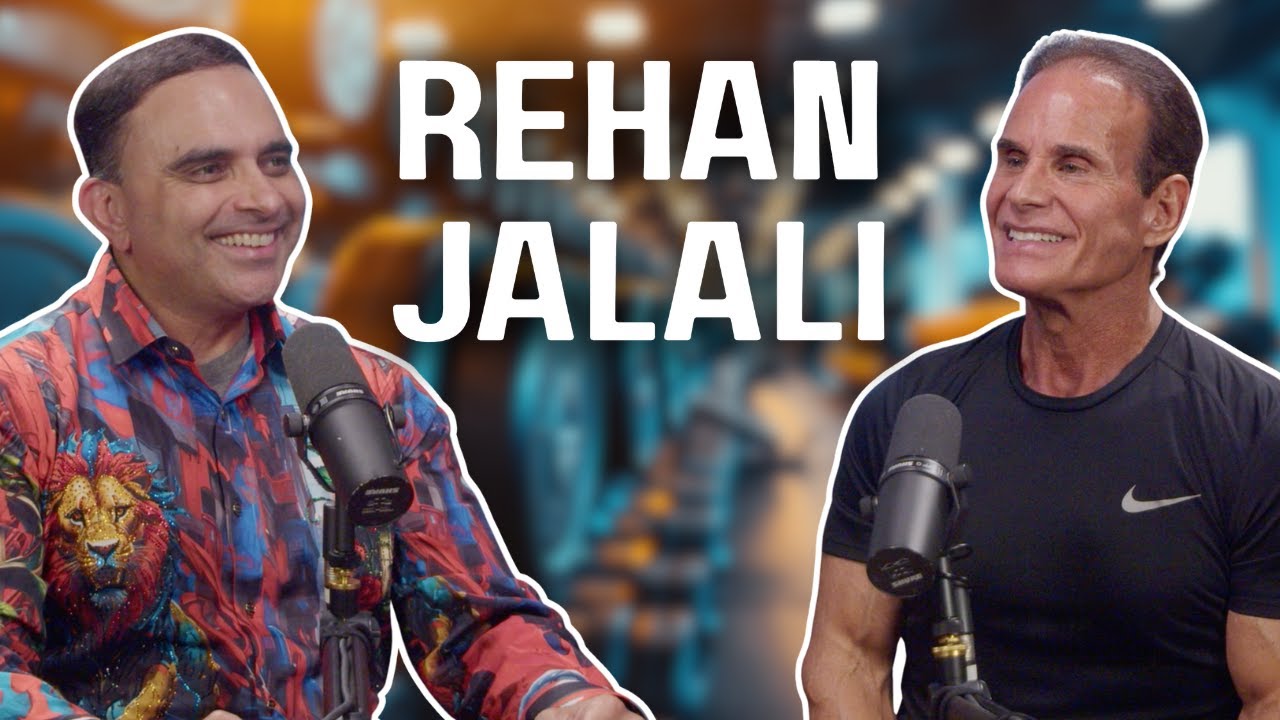
Executive Health Without the Quick Fix: Pav Dharwarkar's Routine
Pav Dharwarkar told Mike Torchia how he guards his health while managing billion-dollar deals: time blocks, two or three workouts a week, no pill cocktails.

You built the career. Somewhere along the way the body that carried you there started sending invoices: the afternoon crash, the joint that aches on the stairs, the sleep that never quite lands. You have the income to fix it, which is exactly why the fixes keep finding you.
Executive health is a market now, and most of what gets sold into it is a pill, a powder, or a program built for speed. Episode 14 of Live Well and Thrive is a 25-minute argument against all three. Mike Torchia’s guest is Pav Dharwarkar, a friend of at least five or six years who, as the episode introduces him, is an entrepreneur doing deals Mike describes as worth hundreds of millions and billions of dollars. He still trains, eats sensibly, and raised children who do the same. What follows is how he does it, in his words and Mike’s.
Why executive health gets sold the wrong way
Pav’s friends are mostly men in their mid-forties with, in his phrase, all the disposable income in the world. That makes them a target. Mike recalls a conversation at Craig’s where Pav described young men following health podcasts and taking as many as 32 different supplements: one for sleep, one for energy, one for focus, one for digestion, one for joint pain.
Pav’s diagnosis is the cleanest line in the episode.
The difference between a marketer and a doctor is a doctor will give you the upside and the downside of everything. A marketer will only pitch you the upside.
The cocktail creates the problem it claims to solve. Pav describes friends who start having sleep issues, cannot tell which substance is doing what, then add another product to fix the side effect of the last one. None of it is FDA regulated, and nobody in the chain is explaining how the pieces interact. Meanwhile, he says, they are searching for a quick fix, and there is no such thing.
He also names the window where the pitch lands hardest: “Especially when you’re between 45 to 55, you’re trying to beat the clock at that point, and that’s when they get you.” The storytelling is good, he concedes. The facts are real but dislocated, stitched into a story that may be backed by science without being fully backed by it. Your body may not need any of it.
Put the workout on the calendar before the meetings
The first thing Pav does is not a workout. It is a plan. His day is blocked around markets, family dinners, and meetings that run into the evening, so the only reliable hour is the one nobody else wants.
Wake up at 5:00 a.m. when no one bugs you. Plan your day out, plan your week out, and when you do that you feel less stressed.
Mike has run his own weeks the same way for more than twelve years. His case against the to-do list is an efficiency case: write ten things down and you will feel fine finishing six of them. Give each task a fixed block and it gets done because the time exists for nothing else. For a busy person that means the workout, the meal, and the investor call sit on the same calendar with the same status.
Executive health, in this version, is a scheduling discipline before it is anything else. Notice what neither man says. Nobody mentions motivation. The structure carries the days when the mood does not.
Executive fitness on two or three sessions a week
Pav is not training for a stage. His routine, as he describes it: two or three sessions a week, a mix of cardio and weights, and sensible eating the rest of the time, without the cheat days that, in his words, catch up to you. The dose is modest. The consistency is not. Mike’s read, looking at him across the table, is that the posture and the health show, and they show because Pav never defers a workout to some time on Monday.
Mike adds his own version of executive fitness, which is about extracting more from the same hour rather than finding a shorter one. He parks on the top level of the gym’s garage and walks down. He sprints the stairs after cardio. “I don’t look for shortcuts. I look for more.” His comparison is the one a financier understands.
When you look at investment, if you look at your health that way, you’ll be smart. You’ll get the results.
Then the line that closes the loop: “It has to be an active process, not passive.”
Test first, then add only what the numbers call for
If the episode has a method, this is it. Most executive health programs start with a product. Mike’s starts with a panel. His rule for supplements is short: “Get a blood test. That’s your road map.” A comprehensive panel tells you where you are actually deficient, and from there a physician or a nutritionist who understands supplementation can fill the specific gap.
Mike is candid that he follows this himself. The only supplements he takes are the ones his own blood work says he is low in, and he adds what he needs rather than medicating over the top of a body that was fine. Vitamins, in his phrase, are over-the-counter drugs. Treat them with that level of respect.
He raises the question the sleep-stack marketers never answer. If you take six things every night to sleep, when do you stop? And if you stop, and your body has adapted, what then? Pav’s answer for himself is that he is at a point where he takes none of it. He eats real food, as close to the ground as he can get it, and he reads the label on anything packaged with an eye on why it lasts so long.
The shortcut math, in Mike’s numbers
The second half of the episode turns to weight loss, the other thing sold hard to men in their forties. Mike’s objection to the GLP-1 drugs is the muscle they cost you, and his alternative is arithmetic: cut 500 calories a day, burn another 500 in training, and two pounds a week adds up without a prescription. His full reasoning, in his own numbers, is in GLP-1 muscle loss: what Mike Torchia would do instead. It is his view, not a prescription; whether it applies to you is a conversation for your physician.
Health is a household system, and a company one
Pav’s most practical observation is about environment. He raised children who exercise and eat well, and the payoff runs both directions. Once the ecosystem is in place, he says, even the days you do not feel like doing it, you do it, because the people around you force you to.
Mike’s own story backs it from the other end. At 14 he felt heavy and it showed in his grades. When he started training, the grades rose with the body. That link between how he felt and how he performed is one of his oldest convictions, and this is where it came from.
A company is an ecosystem too, and it works the same way. A leadership team that blocks its training and eats like adults gives the rest of the building permission to do the same. This is the ground Operation Fitness works on. Mike designs every program; a specialist from his team delivers it, to one executive or to a floor of them. The starting point is the one he argued for in this episode: a health history, blood work with your physician, and a plan built from the results rather than from a podcast. Tested, not guessed. If you buy wellness for a company, the corporate page sets out how a corporate wellness program is scoped, from the first assessment to the specialist on site.
Where to go from here
Watch the full conversation with Pav Dharwarkar on YouTube: https://www.youtube.com/watch?v=B3X4ivUwlNI.
If you are responsible for a team’s health as well as your own, see how Operation Fitness works with companies and institutions.
If you want to start with your own blood work and a program designed around it, request a consultation. Mike replies to everybody.
QUESTIONS PEOPLE ASK
What is executive health?
General context: executive health covers the habits and programs that keep people in demanding leadership roles fit enough to do the job for decades. In this episode, Pav Dharwarkar's version is a planned week, two or three training sessions, sensible food, and no supplement stack he cannot explain. Mike Torchia adds one step: a comprehensive blood test before anything is added.
How many days a week should a busy executive work out?
Pav Dharwarkar trains two or three times a week with a mix of cardio and weights, and says the discipline is in never skipping it. Mike's advice is to make the session more efficient rather than shorter: park on the top level, take the stairs, sprint between stations. Both men block the time in advance so the workout competes with meetings on equal terms.
Should executives take supplements for sleep, focus, and energy?
Mike's view in the episode is that a comprehensive blood test comes first, and the only supplements worth taking are the ones it shows you are low in, chosen with a physician or nutritionist who understands body chemistry. Pav's warning is that marketers pitch only the upside. Neither man recommends a stack built from a podcast. Ask your physician.
What does a corporate wellness program from Operation Fitness look like?
The same order of operations Mike uses with private clients, built for an organization: a conversation about who the program is for, a health history for each participant, bloodwork with their own physician, a program designed by Mike, and a specialist from his team who delivers it on site and adjusts it over time. Details and the inquiry form are on the corporate page.
KEEP READING